
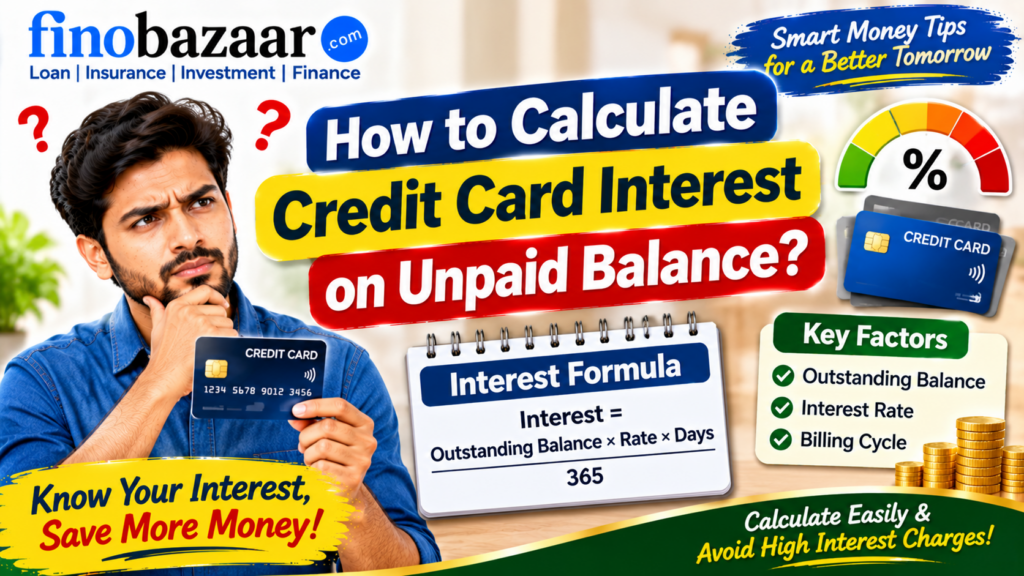
How to Calculate Credit Card Interest on an Unpaid Balance
To calculate credit card interest on an unpaid balance, you need the applicable interest rate, the outstanding amount, and the period for which interest applies. A simple estimate is to multiply the balance by the monthly interest rate. However, your actual credit card statement may use daily balances and transaction dates, so the final charge can be different.
For example, if you have an unpaid balance of ₹20,000 and your card charges an illustrative interest rate of 3.5% per month, the estimated interest for one month would be ₹700 before applicable taxes and other charges.
In India, the Reserve Bank of India (RBI) states that when the total amount due is not paid by the due date, the interest-free credit period is lost and interest may be levied from the transaction date on the outstanding amount, adjusted for payments, refunds, and reversed transactions. Read the RBI’s official credit card FAQs.
Table of Contents
- How credit card interest works
- Credit card interest calculation formula
- Example: interest on an unpaid balance
- Monthly rate vs. daily rate
- What happens if you pay only part of the bill?
- Ways to reduce credit card interest
- Frequently asked questions
How Does Credit Card Interest Work?
Credit card interest, often shown as a finance charge, is the cost of carrying an unpaid balance beyond the payment deadline under your card’s terms.
When you pay the full statement amount by the due date, you can generally retain the interest-free period on eligible purchases. If you do not clear the total amount due, that benefit may be suspended. Interest may then be calculated on the outstanding amount according to the issuer’s terms.
Your actual interest depends on factors such as:
- The interest rate applicable to your card.
- The amount outstanding and how it changes over time.
- The dates of purchases and payments.
- Refunds or reversed transactions.
- Whether you have cash advances or other transactions with different rates.
- The issuer’s calculation method and the terms disclosed in your statement.
There is no single interest rate or formula that applies to every credit card in India. Check your card’s Most Important Terms and Conditions (MITC) and statement for the applicable rate and calculation method.
Credit Card Interest Calculation Formula
1. Simplified monthly interest formula
For a quick estimate, use:
Estimated monthly interest = Outstanding balance × Monthly interest rate ÷ 100
For example, if the balance is ₹20,000 and the assumed monthly rate is 3.5%:
₹20,000 × 3.5 ÷ 100 = ₹700
This is a simplified estimate, not a guaranteed statement amount.
2. Estimate interest using an annual rate
If your card quotes an annual interest rate, you can estimate interest for a period using:
Estimated interest = Outstanding balance × Annual interest rate × Number of days ÷ 365
Use the annual rate as a decimal in this formula. For example, 42% becomes 0.42.
This approximation assumes the balance remains constant throughout the period. Actual card issuers may calculate interest using transaction-level dates and daily outstanding balances.
Example: How to Calculate Interest on an Unpaid Credit Card Balance
Consider this hypothetical example.
| Detail | Illustrative figure |
|---|---|
| Unpaid balance | ₹20,000 |
| Assumed annual interest rate | 42% |
| Approximate monthly rate | 3.5% |
| Calculation period | 30 days |
| Taxes and other charges | Excluded |
Method 1: Monthly estimate
Using a monthly rate of 3.5%:
₹20,000 × 3.5 ÷ 100 = ₹700
The estimated interest for one month is ₹700 before taxes and other charges.
Method 2: Daily estimate using the annual rate
Using the simplified annual-rate formula:
₹20,000 × 0.42 × 30 ÷ 365 = ₹690.41 approximately
The daily-rate estimate is approximately ₹690.41 for 30 days.
Why are the two answers different?
The monthly method uses a fixed 3.5% monthly rate, while the daily method uses 42% divided by 365 and multiplied by 30 days. These are approximations based on different conventions.
Your actual credit card issuer may use a different disclosed calculation method, and the balance may change as purchases, payments, refunds, and other transactions are processed. Therefore, do not treat either example as an exact prediction of your statement.
Monthly Interest Rate vs. Daily Interest Rate
| Feature | Monthly estimate | Daily estimate |
|---|---|---|
| Rate used | Monthly interest rate | Annual rate converted to a daily rate |
| Best for | Quick budgeting estimate | Estimating interest over a specific number of days |
| Main limitation | May not reflect the issuer’s actual method | Assumes a constant balance unless adjusted day by day |
| Exact statement match? | Not guaranteed | Not guaranteed |
For a more detailed estimate, calculate interest for each period during which the outstanding balance remains unchanged, then add the amounts together. Even this approach may not match the statement unless it follows your issuer’s precise rules and transaction dates.
What Happens If You Pay Only Part of Your Credit Card Bill?
Suppose your statement shows ₹25,000 due, but you pay ₹5,000 by the due date.
The remaining amount before interest and other adjustments is:
₹25,000 − ₹5,000 = ₹20,000
That ₹20,000 is not necessarily the exact amount on which the issuer will calculate every finance charge. Payments, refunds, transaction dates, and card terms can affect the calculation. If the total amount due is not cleared, the interest-free period may be suspended.
Paying more than the minimum amount due can reduce the unpaid balance, but it does not automatically eliminate interest. To understand the effect of partial payment, see the RBI’s official credit card FAQs.
How to Reduce Credit Card Interest Charges
1. Pay the full statement amount by the due date
Where possible, pay the total amount due by the deadline. This is generally the most effective way to avoid purchase finance charges on eligible transactions, subject to your card’s terms.
2. Pay more than the minimum amount due
If you cannot clear the entire bill, paying more than the minimum can reduce the balance that carries forward. However, interest may still apply.
3. Avoid adding new purchases while carrying a balance
When the interest-free period has been suspended, new purchases may also attract finance charges under your card’s terms. Consider avoiding further spending until the outstanding balance is cleared.
4. Check your card’s actual interest rate
Review the finance-charge section of your monthly statement or MITC. Check whether the card has different rates for purchases and cash advances.
5. Review every finance charge on your statement
Compare the interest amount, applicable taxes, and fees with your issuer’s disclosed terms. Contact the issuer if a charge appears inconsistent with the statement or card agreement.
6. Set payment reminders
Set a reminder several days before the due date. If you use automatic payments, make sure the linked bank account has enough funds and confirm that the payment succeeded.
Common Mistakes to Avoid
- Assuming every credit card has the same interest rate.
- Treating a monthly estimate as the exact bank calculation.
- Assuming interest applies only to the balance remaining on the payment due date.
- Forgetting that transaction dates and payments can affect finance charges.
- Assuming that paying the minimum due preserves the interest-free period.
- Ignoring the card issuer’s MITC and statement breakdown.
Frequently Asked Questions
1. How do I calculate credit card interest on an unpaid balance?
For a quick estimate, multiply the unpaid balance by the monthly interest rate and divide by 100. For example, ₹10,000 at an assumed monthly rate of 3% gives an estimated interest amount of ₹300 for one month, before taxes and other charges. The actual statement may use a different calculation method.
2. How much interest is charged on a ₹20,000 credit card balance?
It depends on the card’s interest rate, the period, and the issuer’s calculation method. At an assumed monthly rate of 3.5%, a simplified one-month estimate is ₹700 before taxes and other charges.
3. How do I calculate credit card interest per day?
A simplified estimate is to multiply the balance by the annual interest rate and the number of days, then divide by 365. For exact charges, use the issuer’s disclosed method and account for changes in the daily balance.
4. Does credit card interest apply if I pay the minimum amount due?
Yes, interest may apply to the outstanding amount if you do not clear the total amount due by the payment deadline. The interest-free period may be suspended under the card’s terms.
5. Is credit card interest calculated on the full bill or the unpaid balance?
RBI guidance states that interest may be levied on the outstanding amount, adjusted for payments, refunds, and reversed transactions, rather than simply on the total amount due. The exact calculation follows the applicable rules and card terms.
6. Why is my credit card interest higher than my estimate?
Your estimate may not account for transaction dates, changes in outstanding balances, different interest rates for different transaction types, or the issuer’s calculation method. Review the statement and contact the issuer if you cannot reconcile the amount.
7. Does paying the outstanding balance stop all credit card charges?
Paying the outstanding balance can reduce or stop further interest on that balance, subject to the card’s terms and the payment being credited. Charges already incurred, pending transactions, fees, or other outstanding amounts may still appear on the statement.
8. Where can I find my credit card’s interest rate?
Check your monthly statement, your card issuer’s official website, or the Most Important Terms and Conditions. Use the rate applicable to your transaction type rather than assuming one rate applies to every transaction.
Conclusion
To calculate credit card interest on an unpaid balance, start with the outstanding amount and the applicable interest rate. A simple monthly formula is useful for budgeting, but actual finance charges can depend on daily balances, transaction dates, payments, and your issuer’s terms.
Whenever possible, clear the full statement amount by the due date. If you carry a balance, review your statement carefully and use your card’s disclosed calculation method to understand the actual cost.
Disclaimer: This article is for general financial education and does not provide personalised financial advice. Rates and calculations vary by card issuer and account terms. Check your statement and the issuer’s official documents before making repayment decisions.
Official reference
- Reserve Bank of India, Credit Card and Debit Card FAQs: https://www.rbi.org.in/commonman/Upload/English/FAQs/PDFs/FAQMDCreditCardandDebitCard.pdf
- Reserve Bank of India, Master Direction – Credit Card and Debit Card – Issuance and Conduct Directions, 2022 (updated March 7, 2024): https://systemhealth.rbi.org.in/Scripts/BS_ViewMasDirections.aspx_id%3D12300.html