
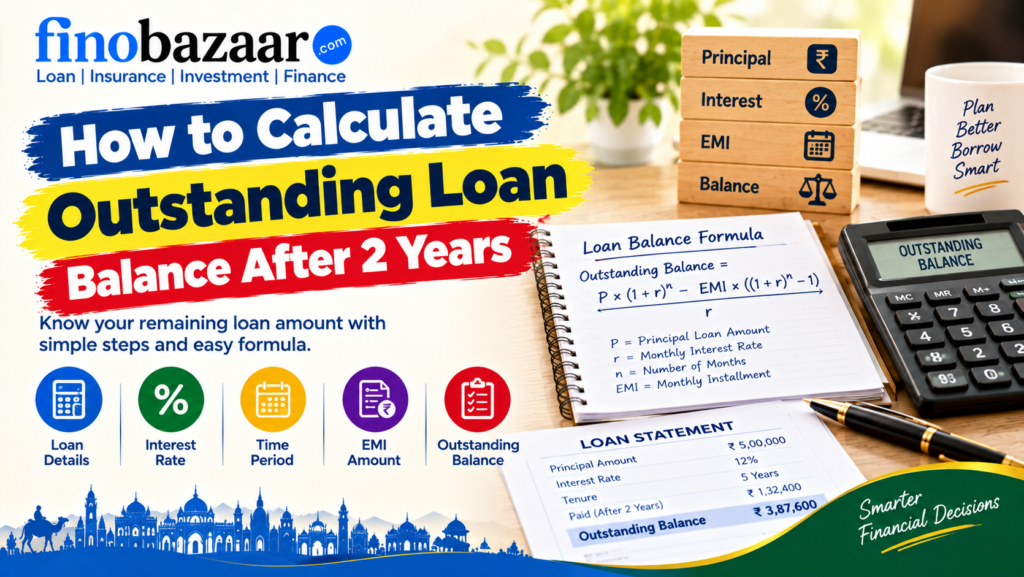
How to Calculate Outstanding Loan Balance After 2 Years
If you want to calculate your outstanding loan balance after 2 years, you need your original loan amount, annual interest rate, total loan tenure, and the number of EMIs you have paid. For a regular monthly reducing-balance loan, the remaining principal can be calculated using a loan amortization formula or estimated with a suitable loan calculator.
For example, if you borrow ₹5,00,000 at 10% annual interest for 5 years, your monthly EMI is approximately ₹10,624. After making 24 regular EMIs, your outstanding principal would be approximately ₹3,29,236, assuming the interest rate and EMI remain unchanged and there are no extra payments or missed instalments.
This guide explains the formula, a step-by-step calculation, how principal and interest change over time, and how to check the amount with your lender.
Table of Contents
- What Is an Outstanding Loan Balance?
- How to Calculate Outstanding Loan Balance After 2 Years
- Outstanding Loan Balance Formula
- Worked Example: ₹5 Lakh Loan After 2 Years
- How Much Principal Have You Repaid?
- How to Calculate Your Balance Step by Step
- How to Check Your Actual Outstanding Loan Amount
- Which FinoBazaar Calculators Can Help?
- Common Calculation Mistakes
- Frequently Asked Questions
What Is an Outstanding Loan Balance?
The outstanding loan balance is the principal amount that remains unpaid on your loan at a particular point in time. It decreases as your EMI payments repay the principal.
A typical EMI contains two components:
- Interest: The charge for borrowing money during that period.
- Principal repayment: The portion that reduces the amount you originally borrowed.
At the beginning of many reducing-balance loans, a larger part of the EMI goes towards interest. As the principal decreases, the interest component generally falls and more of the EMI goes towards principal repayment.
Your outstanding principal is not necessarily the same as your final loan closure amount. A lender’s payoff or foreclosure quote may include interest accrued up to the payment date and applicable charges, if any.
How to Calculate Outstanding Loan Balance After 2 Years
For a loan with monthly EMIs, two years normally means 24 monthly payments. If you have made all 24 payments on time, you can calculate the remaining principal using the loan’s amortization formula.
You will need:
- Original loan amount
- Annual interest rate
- Total loan tenure in months
- Number of EMIs already paid
- Any rate changes, missed payments or additional principal payments
For a fixed-rate loan with regular EMIs, the outstanding balance can be calculated mathematically. If the interest rate or EMI changed during the first two years, a month-by-month repayment schedule or your lender’s loan statement will usually provide a more reliable result.
Outstanding Loan Balance Formula
For a standard monthly reducing-balance loan with equal monthly EMIs, the outstanding principal after a specified number of payments can be calculated as:
Outstanding Balance = P × [(1 + r)^n − (1 + r)^k] ÷ [(1 + r)^n − 1]
Where:
- P = Original loan principal
- r = Monthly interest rate, expressed as a decimal
- n = Total number of monthly instalments
- k = Number of EMIs already paid
To convert an annual interest rate into a monthly rate:
Monthly interest rate = Annual interest rate ÷ 12 ÷ 100
For example, an annual interest rate of 10% gives a monthly rate of approximately 0.008333, or 0.8333%.
This formula assumes regular payments at the end of each month, a constant interest rate and no additional principal payments or overdue amounts.
Worked Example: ₹5 Lakh Loan After 2 Years
Let’s calculate the outstanding loan balance using hypothetical figures.
| Loan detail | Example value |
|---|---|
| Original loan amount | ₹5,00,000 |
| Annual interest rate | 10% |
| Total loan tenure | 5 years (60 months) |
| EMIs paid | 24 |
| Approximate monthly EMI | ₹10,624 |
| Outstanding principal after 2 years | ₹3,29,236 |
Figures are illustrative estimates rounded to the nearest rupee. The actual result may differ due to lender-specific calculations, payment dates, interest-rate changes or charges.
Step 1: Convert the annual rate into a monthly rate
Annual interest rate = 10%
Monthly rate = 10 ÷ 12 ÷ 100
Monthly rate = approximately 0.008333.
Step 2: Identify the total and completed EMIs
Total tenure = 60 months.
Payments already made = 24 months.
Remaining scheduled instalments = 60 − 24 = 36 months.
Step 3: Calculate the EMI
For a standard reducing-balance loan, the EMI formula is:
EMI = P × r × (1 + r)^n ÷ [(1 + r)^n − 1]
Using a principal of ₹5,00,000, a monthly rate of approximately 0.008333 and a 60-month tenure, the EMI is approximately ₹10,624.
Step 4: Calculate the outstanding principal
Apply the outstanding balance formula:
Outstanding balance = ₹5,00,000 × [(1 + r)^60 − (1 + r)^24] ÷ [(1 + r)^60 − 1]
Using the monthly rate of 10% ÷ 12 ÷ 100:
Estimated outstanding principal after 24 EMIs = ₹3,29,236.
This is the remaining principal under the stated assumptions, not necessarily the exact amount required to close the loan on a particular date.
How Much Principal Have You Repaid After 2 Years?
In the example above, the borrower has paid approximately ₹2,54,965 in total EMIs over 24 months.
| Calculation | Approximate amount |
|---|---|
| Total of 24 EMIs | ₹2,54,965 |
| Original loan principal | ₹5,00,000 |
| Outstanding principal after 24 EMIs | ₹3,29,236 |
| Principal repaid during the period | ₹1,70,764 |
| Interest included in the 24 EMIs | ₹84,201 |
The principal repaid is calculated as the original principal minus the outstanding principal. The interest paid is estimated as total EMIs paid minus principal repaid.
The numbers are rounded, so small differences may occur when values are calculated using unrounded figures.
This example shows why you should not simply subtract all your EMI payments from the original loan amount. Part of every EMI pays interest rather than reducing principal.
How to Calculate Your Balance Step by Step
Follow these steps to estimate your remaining loan principal after two years.
- Find your original loan amount. Use the amount actually disbursed, taking account of any disbursements made in stages.
- Check your applicable interest rate. Use the rate charged during the repayment period, not an assumed rate.
- Confirm the original tenure. Convert years into months. For example, a 10-year loan normally has 120 monthly instalments.
- Count the EMIs paid. Two years of monthly repayments usually means 24 payments, but use your actual payment history.
- Calculate the outstanding principal. Apply the formula above or use an amortization schedule that supports your loan details.
- Compare the estimate with your loan statement. Account for any prepayments, missed instalments, rate resets or changes in EMI.
- Ask for a closure quote if you intend to repay the loan in full. The final amount may differ from the outstanding principal shown in a calculation.
Does the Outstanding Balance Depend on the Loan Interest Rate?
Yes. For the same original principal, tenure and number of EMIs, a different interest rate changes the EMI and the amount of principal repaid over time.
The following table is a conceptual comparison, not a set of calculated loan offers. For a meaningful comparison, keep the principal, tenure, payment history and rate assumptions consistent.
| Factor | Possible effect on outstanding balance |
|---|---|
| Higher interest rate | With the same tenure, more of each payment may go towards interest. |
| Longer loan tenure | EMI is usually lower, and principal may reduce more slowly during the early years. |
| Extra principal payment | Usually reduces the principal balance when credited towards the loan. |
| Missed EMI | May leave the balance higher and can result in overdue amounts or charges. |
| Floating-rate change | Can affect EMI, remaining tenure or both, depending on the lender’s terms. |
For an accurate comparison, calculate each scenario using the actual loan terms rather than relying on general rules alone.
How to Check Your Actual Outstanding Loan Amount
A formula provides an estimate, but your lender’s records are the best starting point for your actual loan balance.
You can generally:
- Download the latest loan account statement through your lender’s website or mobile app.
- Check the repayment or amortization schedule provided when the loan was approved.
- Contact customer support or visit a branch and request the outstanding principal as of a specific date.
- Request a foreclosure or loan closure statement if you plan to repay the entire amount.
For floating-rate loans, review any rate resets and changes to your EMI or tenure. The Reserve Bank of India has published guidance on EMI-based floating-rate personal loans, including communication about the effects of interest-rate resets and repayment options. Read the relevant RBI guidance and confirm which rules apply to your particular loan.
Which FinoBazaar Calculators Can Help?
FinoBazaar’s relevant calculator pages should be used only after confirming that the live pages are available and that their features match the calculation you need.
1. FinoBazaar EMI Calculator
An EMI calculator helps estimate the monthly instalment from the loan amount, interest rate and tenure. It is useful for understanding the payment structure, but an EMI calculator alone may not calculate the remaining principal after 24 payments unless it includes an amortization schedule or outstanding-balance feature.
Try the relevant tool: [INTERNAL LINK REQUIRED: FinoBazaar EMI Calculator]
2. FinoBazaar Loan Interest Calculator
A loan interest calculator can help estimate the interest cost of borrowing. Check whether the existing tool uses the reducing-balance method and whether it supports a remaining-balance calculation before relying on it for this purpose.
Explore the relevant tool: [INTERNAL LINK REQUIRED: FinoBazaar Loan Interest Calculator]
3. FinoBazaar Personal Loan Calculator
If you are checking a personal loan, a personal-loan calculator may help estimate EMI and repayment costs. Confirm that the tool supports the loan type and inputs you need.
Calculate your loan: [INTERNAL LINK REQUIRED: FinoBazaar Personal Loan Calculator]
Important: These are internal-link placeholders, not verified live links. Do not publish them as clickable links until the existing FinoBazaar URLs and calculator features have been checked. Do not create a duplicate calculator if a suitable tool already exists.
Common Mistakes When Calculating Outstanding Loan Balance
Avoid these common errors:
- Subtracting total EMIs from the original principal: EMIs include both interest and principal.
- Using the annual rate as a monthly rate: Convert the annual percentage into a monthly decimal.
- Assuming every loan uses the same method: Flat-rate loans and reducing-balance loans work differently.
- Ignoring rate changes: A floating-rate loan may have a different repayment schedule after a reset.
- Ignoring prepayments or missed instalments: These change the balance or the amount due.
- Treating outstanding principal as the closure amount: Accrued interest and applicable charges can change the final payoff figure.
- Relying on rounded values: Use unrounded calculations for the closest estimate and compare with your lender’s statement.
Frequently Asked Questions
1. How do I calculate outstanding loan balance after 2 years?
For a regular monthly reducing-balance loan, use the original principal, monthly interest rate, total tenure in months and the number of EMIs paid. Insert these values into the outstanding balance formula. For two years of monthly payments, the payment count is usually 24.
2. What is the outstanding balance on a ₹5 lakh loan after 2 years?
It depends on the interest rate, original tenure, EMI history and any prepayments. In the hypothetical example in this article, a ₹5 lakh loan at 10% annual interest over 5 years has an estimated outstanding principal of ₹3,29,236 after 24 regular EMIs.
3. Is the outstanding loan balance the same as the remaining EMIs?
No. The sum of the remaining EMIs includes future interest under the scheduled repayment plan. The outstanding principal is the remaining principal amount. The two figures are generally different.
4. Does the outstanding balance include future interest?
The outstanding principal normally refers to the principal still unpaid, excluding interest that has not yet accrued. A lender’s final payoff quote may include interest accrued up to the payment date and applicable charges.
5. Can I calculate my loan balance after 24 EMIs without knowing the EMI?
Yes, if you know the original principal, applicable interest rate, total tenure and payment count, you can use the standard amortization formula to estimate the balance. If your loan terms or payment history changed, use the actual repayment schedule.
6. How can I check my exact outstanding home loan balance?
Check your latest home loan statement or request the balance from your lender for a specified date. A calculator gives an estimate, while the lender’s account records reflect posted payments and applicable adjustments.
7. Does prepaying a loan reduce the outstanding balance?
A payment credited towards principal generally reduces the outstanding principal. The effect on future EMI or loan tenure depends on the lender’s process and the option selected. Check how the lender applies the payment.
8. Can the outstanding balance increase after two years?
It can differ from the expected schedule if payments are missed, interest rates change, instalments are adjusted, or other amounts are added under the loan agreement. Review your loan statement to understand the reason for any increase.
9. Which calculator should I use to calculate the remaining loan amount?
Use a calculator that specifically supports outstanding principal or a month-by-month amortization schedule. A basic EMI calculator may only estimate the instalment and total repayment, so confirm its features before using it for a balance calculation.
10. Is the outstanding loan balance formula the same for every loan?
No. The formula above applies to a standard loan with equal monthly payments and a constant rate under the stated assumptions. Flat-rate loans, variable-rate loans, irregular payments and loans with staged disbursements may require a different calculation or a detailed repayment schedule.
Conclusion
To calculate your outstanding loan balance after 2 years, determine how much principal remains after your first 24 monthly payments. Use the amortization formula for a fixed-rate, regular-EMI loan, or review a repayment schedule that reflects your actual loan terms.
For the most reliable figure, compare your estimate with your lender’s latest statement. If you plan to close the loan, request a dated payoff or foreclosure quote rather than relying only on the calculated principal.
Financial information disclaimer: This article is for educational purposes and provides illustrative calculations, not a lender’s official payoff figure or personalised financial advice. Actual balances depend on your loan agreement, payment history, interest-rate changes and applicable charges.