
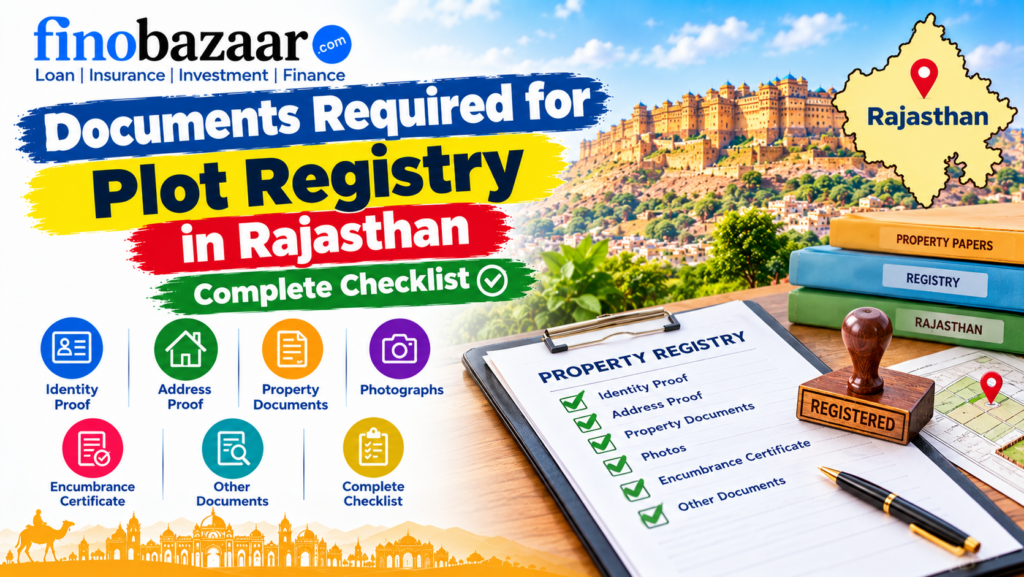
Documents Required for Plot Registry in Rajasthan: Complete Checklist
The documents required for plot registry in Rajasthan generally include valid identity documents for the parties, the sale deed or other appropriate transfer document, property ownership records, plot identification details, payment information and witness details. Additional papers may be required depending on whether the plot is in a housing society, an urban development authority scheme, a municipal area, a Gram Panchayat area or an agricultural landholding.
The Rajasthan Registration and Stamps Department uses its e-Panjiyan system for property registration. Its official guidance identifies party details, property details, consideration, deed terms, witness details and signatures as key parts of the registration process. The final checklist should be confirmed for your particular transaction through the official portal or the relevant Sub-Registrar office.
Table of Contents
- Basic documents required for plot registry
- Buyer and seller identity documents
- Property ownership documents
- Additional documents for specific types of plots
- How to register a plot in Rajasthan
- Stamp duty and registration fees
- Common mistakes to avoid
- Frequently asked questions
1. Basic Documents Required for Plot Registry in Rajasthan
Use this checklist to prepare for a typical plot sale. It is a general preparation guide, not a guarantee that every document listed is mandatory in every transaction.
| Document | Why it may be needed |
|---|---|
| Sale deed or applicable transfer deed | Records the terms and transfer of the property |
| Buyer’s identity proof | Helps establish the buyer’s identity |
| Seller’s identity proof | Helps establish the seller’s identity |
| PAN card, where applicable | Identity and transaction-related requirements |
| Latest available Jamabandi or relevant land record | Helps check recorded land details and rights |
| Khasra number and plot identification details | Helps identify the property being transferred |
| Patta, allotment letter or lease deed, where applicable | Supports the seller’s rights under the relevant allotment or lease |
| Previous title deed or ownership documents | Helps examine the ownership history |
| Property map, site plan or layout details, where applicable | Helps identify the plot and its location |
| Stamp duty and registration fee payment details | Supports verification of the applicable charges |
| Witness details and required signatures | Part of the registration process |
| Photographs, biometrics or other required verification | May be captured or requested during registration |
Important: The exact requirements depend on the nature of the property and the transaction. Confirm the document checklist generated or specified by the Rajasthan e-Panjiyan system and the relevant Sub-Registrar office.
2. Identity Documents for the Buyer and Seller
The buyer and seller should prepare valid identity documents before starting the registration process.
The Rajasthan e-Panjiyan FAQ lists Aadhaar card, Jan Aadhaar card and PAN card among the identity documents accepted for registration-related identification. The documents required in a particular case should still be checked against the current portal instructions.
Buyer’s documents
Prepare the following, as applicable:
- An accepted identity document.
- PAN card, where required for the transaction.
- Current contact details, including a working mobile number.
- Any additional information or document requested by the registration system or Sub-Registrar.
Seller’s documents
The seller should prepare:
- An accepted identity document.
- PAN card, where applicable.
- Relevant ownership and transfer documents.
- Any additional documents required to establish the seller’s authority to transfer the plot.
If a property has multiple recorded owners, co-owners or other persons whose consent or participation is legally required, establish who must sign or appear before preparing the final deed.
Official reference: Rajasthan e-Panjiyan FAQ.
3. Property Ownership Documents to Check Before Plot Registry
Identity documents alone do not establish that the seller has the right to sell a particular plot. The ownership and property records need separate examination.
A. Previous sale deed or title document
Review the document through which the seller acquired the property. Compare the seller’s name, property description, area and identifying details with the proposed sale deed.
Where there have been previous transfers, examine the available chain of title documents. A single document should not automatically be treated as proof that every ownership issue has been resolved.
B. Jamabandi and Khasra details
For land recorded in Rajasthan’s revenue system, check the relevant Jamabandi, Khasra number and available land records. These can help identify recorded rights and land particulars.
The exact records relevant to an urban plot may differ from those relevant to agricultural land or a rural parcel. Confirm which record applies to the property.
C. Patta, allotment letter or lease deed
If the plot was allotted by a development authority, local body, housing scheme or another institution, review the applicable patta, allotment letter, lease deed and transfer conditions.
Do not assume that an allotment letter alone establishes an unrestricted right to transfer the plot. The scheme’s terms may impose conditions or require permission, payment or other formalities.
D. Plot number, area and boundaries
Compare the proposed deed with the available plot records, including:
- Plot number and location.
- Recorded area and measurement unit.
- Khasra number, where relevant.
- Boundaries and adjoining plots, where recorded.
- Layout or site-plan details, where applicable.
Resolve material discrepancies before proceeding with registration.
E. Authority to sell
If the seller is acting through a power of attorney, as a legal representative, or on behalf of an organisation, additional documents may be necessary. The validity, scope and legal effect of those documents should be checked for the specific transaction.
4. Additional Documents for Different Types of Plots
Not every plot has the same documentation history. The following are examples of additional documents that may be relevant.
| Type of plot | Additional records to check |
|---|---|
| Housing society plot | Society allotment, patta or transfer records and applicable society requirements |
| Development authority or local-body plot | Allotment letter, lease deed, patta, transfer permission or dues information, as applicable |
| Agricultural land | Relevant Jamabandi, Khasra and other revenue or land-use records |
| Inherited property | Relevant succession, inheritance, mutation or court documents, depending on the circumstances |
| Jointly owned property | Ownership documents and participation or authority of the persons whose consent or signatures are legally required |
| Leasehold plot | Lease deed and applicable transfer or lessor-permission requirements |
| Property represented by an authorised person | Relevant power of attorney or other authority documents, subject to legal validity and registration requirements |
This table is a preparation guide, not a universal mandatory-document list. Ask the relevant authority which documents apply to the property’s legal status and transfer type.
5. How to Register a Plot in Rajasthan
Rajasthan’s official e-Panjiyan process allows citizens to enter relevant information online and proceed with registration. The official workflow describes entering property, party and payment details, submitting supporting documents, attending the designated Sub-Registrar office and completing the required verification.
Step 1: Verify the property and seller
Before paying the full purchase amount, check the seller’s ownership documents, property identity, available land records and any relevant transfer restrictions. Consider professional legal review where the title or ownership history is unclear.
Step 2: Prepare the sale deed
Prepare the sale deed or other applicable transfer document with accurate party details, consideration, property description, conditions and declarations.
The deed should match the verified records. Do not copy a deed from another property without checking the details.
Step 3: Enter the information on e-Panjiyan
Use the official portal to enter the required property, party and payment information. Follow the instructions applicable to the selected deed type and transaction.
Official portal: Rajasthan e-Panjiyan.
Step 4: Check the applicable charges
Review the stamp duty, registration fee, any applicable surcharge or concession and other charges shown for the particular transaction. Do not rely on an old estimate if the applicable rates or fee rules have changed.
Step 5: Submit the required documents
Upload or provide the supporting documents as instructed. Keep the originals available for examination when required by the registration office.
Step 6: Attend the Sub-Registrar office
Follow the appointment or attendance instructions provided by the portal. The registration workflow may include document verification, confirmation of execution, photographs, biometrics and signatures of the relevant parties and witnesses.
Step 7: Obtain the registered document
After the registration office completes its checks and registers the deed, follow the official instructions for receiving the registered document and its registration details.
The official process may require corrections if documents or information are incomplete or inconsistent.
Official reference: Property Registration Procedure — Rajasthan e-Panjiyan.
6. Stamp Duty and Registration Fees for Plot Registry
Stamp duty and registration fees are separate from the documents themselves. The amount payable depends on the deed type, applicable valuation, prevailing rules and any eligible concession.
The Rajasthan Registration and Stamps Department states that updated rates should be checked in the fee master available through the department’s website.
Before making payment:
- Select the correct deed type.
- Enter the property and party details accurately.
- Check the applicable valuation and charges displayed by e-Panjiyan.
- Review any applicable concession or additional charge.
- Keep payment acknowledgements and transaction references.
You can also use the FinoBazaar DLC Value Calculator to estimate the DLC value of land where the tool’s inputs and intended use are relevant.
Remember: A DLC estimate is not a complete registration bill and does not confirm that a plot has a clear title.
7. Common Mistakes to Avoid Before Plot Registry
Relying only on a photocopy of the seller’s deed
Compare the available documents with official records and obtain appropriate legal review where necessary.
Ignoring the plot’s legal status
A plot’s location in a society, authority scheme, agricultural holding or leasehold arrangement can affect the documents and permissions required.
Using inconsistent property details
Differences in plot number, area, Khasra details, names or boundaries may delay registration or create later disputes. Resolve material inconsistencies before signing.
Assuming mutation proves ownership by itself
Mutation and revenue entries are important records, but they should be considered alongside the underlying title documents and the applicable legal circumstances.
Paying without checking the applicable charges
Use the current e-Panjiyan fee information for the particular transaction rather than relying solely on a broker’s estimate or an old calculation.
Treating registration as a substitute for due diligence
Registration formalities and title verification are related but distinct. Examine ownership, transfer authority, encumbrances and relevant land-use or scheme restrictions as appropriate.
8. Frequently Asked Questions
1. What documents are required for plot registry in Rajasthan?
For a typical sale, prepare the applicable sale deed, accepted identity documents for buyer and seller, ownership and property records, payment details and witness information. Additional documents depend on the plot’s ownership history, legal status and transfer type.
2. Is Aadhaar card compulsory for plot registration in Rajasthan?
The Rajasthan e-Panjiyan FAQ lists Aadhaar, Jan Aadhaar and PAN among accepted identity documents. Confirm the current instructions for the specific transaction rather than assuming that one document is the only acceptable option.
3. Is PAN card required for plot registry?
PAN may be required depending on the transaction and applicable rules. Check the current e-Panjiyan instructions and any applicable tax requirements for your case.
4. Is Jamabandi required for every plot registry?
Not necessarily in the same form for every property. Jamabandi and Khasra records are relevant to land recorded in the revenue system, while an urban or authority-allotted plot may have different principal records. Confirm the applicable documents for the specific plot.
5. Is a patta enough to register a plot?
Not in every case. The patta’s terms, the issuing authority, transfer restrictions, current ownership and other applicable requirements must be checked. Additional documents or permissions may be necessary.
6. Do buyer and seller both need to attend the Sub-Registrar office?
The registration process includes verification and execution requirements for the relevant parties. The attendance or authorised-representation requirements depend on the transaction and applicable rules. Follow the instructions issued by the registration office.
7. Are witnesses required for plot registry in Rajasthan?
The official e-Panjiyan FAQ identifies witness details and signatures as part of the registration information. Confirm the number, eligibility and identification requirements for the selected deed type with the current official instructions.
8. Can I start plot registration online in Rajasthan?
Yes. The official e-Panjiyan system supports online entry of property, party and payment information. You may still need to attend the designated Sub-Registrar office and complete the required verification steps.
9. How can I check the stamp duty and registration fee for a plot?
Check the current fee master and the charge calculation provided through the official e-Panjiyan portal for the particular deed and property details. The applicable amount can depend on the transaction and any eligible concessions.
10. What should I check before buying a plot in Rajasthan?
Check the seller’s title documents, relevant revenue or allotment records, plot identity, area, transfer restrictions and available information about encumbrances or disputes. Where needed, obtain a qualified property lawyer’s review before paying or signing.
Conclusion
Preparing the documents required for plot registry in Rajasthan starts with identifying the plot’s legal status and checking the buyer’s, seller’s and property’s records. A typical transaction involves identity proof, an appropriate transfer deed, ownership documents, accurate plot details, payment information and witness details, but additional requirements vary by property and deed type.
Use the official Rajasthan e-Panjiyan portal to confirm the current process and charges. For a preliminary DLC valuation estimate, visit the FinoBazaar DLC Value Calculator.
Disclaimer: This article is for general information, not legal advice. The checklist is not exhaustive and does not replace the official checklist or a title review. Confirm transaction-specific requirements with the registration office and seek qualified legal advice where ownership or transfer rights are uncertain.